
An Introduction to AI Literacy
It helps to know the basics of how AI tools work, especially if you want to get the most out of them. This page is an introduction to the technology behind generative AI tools, like ChatGPT.


Why is AI literacy important?
Artificial Intelligence has been around for a while, but it's taken monumental strides in recent years. This isn't just another tech buzzword, it's a paradigm shift that's changing how we design learning experiences.
AI literacy means having the basic knowledge of how AI works, plus the skills to use it responsibly and effectively. Developing your AI literacy will help you to:



Elevate your learning design
Futureproof your career
Navigate the AI Landscape
Choose and use AI tools more effectively and ethically.
Keep up with AI advancements and boost your career prospects; employers are looking for AI-savvy people.
AI can help with various LD tasks from coming up with ideas to editing text and analysing learner data.

By developing your AI literacy, you're not just keeping pace with the present; you're investing in your future and developing your professional toolkit.
What is AI?
AI, (Artificial Intelligence) is a branch of computer science where systems can perform tasks usually requiring human intelligence. AI has been around for years and is already part of our daily lives, in personalised ads, streaming services, voice assistants, etc.
Today, AI systems are narrow, meaning they can perform specific tasks. The humanoid robots you see in sci-fi movies are general AI, as they can perform any task a human can, often better.

How do AI models learn and improve?
AI systems are like super diligent students studying vast amounts of information to get smarter. This ability to learn from data is called machine learning.
Machine learning can happen in two ways: supervised or unsupervised. Supervised learning uses data which is labelled and classified. It's like giving students a textbook activity with a clearly defined structure and the answers in the back to check their work. Unsupervised learning, on the other hand, is like giving a student a project without strict guidelines, letting them explore and derive their own conclusions.
Early AI models depended on humans programming rules — imagine how many rules would be needed just to master English! Now, AI systems can learn unsupervised picking up rules and patterns for themselves to develop a greater intelligence.
This greater ability to learn has been made possible by technological advancements and the vast amounts of data available. Complex machine learning models with deep learning have layers upon layers of data to draw upon. One example of such a complex model is a large language model (LLM), the technology behind generative AI tools like ChatGPT.

ChatGPT naked — A basic representation of a neural network, with layers of interconnected data.
How does generative AI, like ChatGPT, work?
Generative AI uses large language models (LLMs) with neural networks to create text, images, audio, and more.
Large language models (LLMs) are trained on vast datasets, like online books, articles and posts, which they use to learn the fundamentals of language. This digital 'wisdom' is organised into a neural network, inspired by how our brains organise and connect information. This creates an intricate web of language, which it uses to understand your prompts and produce text, images, audio or code. On top of this, LLMs are then fine-tuned by humans to ensure they give suitable (and hopefully ethical) outputs.
Imagine an LLM as a digital librarian that has read all of Shakespeare's works. When it comes across Shakespearean phrases or themes, it recalls the essence and style from its 'readings'. Thus, if you ask it to craft a sentence in the style of Shakespeare, it accesses its vast 'memory' of Shakespearean literature to craft a sentence that mimics his style.
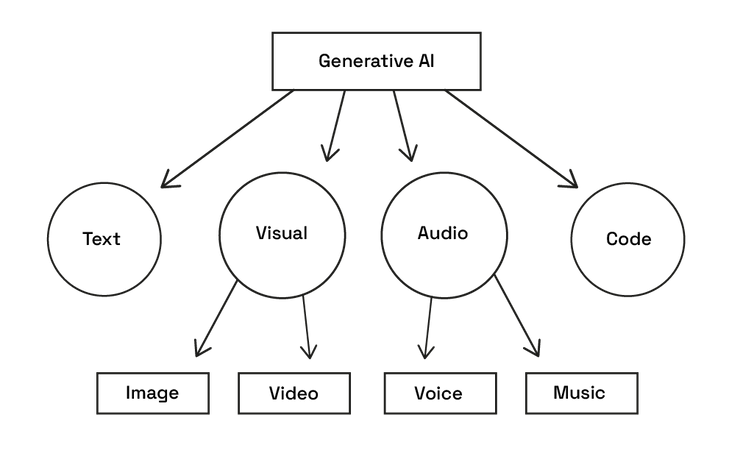
Types of generative AI: Text, visual, audio and code. A combination of these is called 'multimodal'.
Generative AI tools work by paying attention to key terms in your prompt and then predicting the best answer by drawing on data from its network.
So, when you ask a text generator, like ChatGPT, what the capital of France is, it responds "Paris" — not because it understands geography, but because this answer aligns closely with its training data, as Paris has a strong connection with the words capital and France.
Generative AI tools can also create images. They are trained on massive datasets of images, learning the visual patterns and relationships between different elements. When you give it a prompt, such as "a snowy Eiffel Tower under a starry sky," it references its training data to identify relevant visual elements associated with ‘snowy’, the ‘Eiffel Tower’ and ‘a starry sky". Using this information, it generates an image that aligns with the given description.
So, how does this help you use AI?
The key to unlocking a more accurate, insightful or creative output lies in how you collaborate with AI.
Providing clear instructions and context helps direct the AI to the most relevant information in its data network. This is done by writing specific, clear and informative prompts or using techniques to tweak the AI's output.
If your prompts aren't written well or lack information, you aren't giving the AI all it needs to find the best information to use for the task. This is like setting an essay without clear guidelines or criteria; students might write extensively, but they are less likely to produce work that is in line with your expectations.
Generative AI models are largely trained from data on the internet, much of which is written in a marketing style to a mass audience for search engine optimisation (SEO). This is why answers often lack creativity or insight, because the answer is based on what’s most common or likely from the training data. So, it's up to you to guide the AI to give you the response you need.

Visit the prompting page next, which has tips, techniques and examples to help you get the most out of generative AI.
Develop your AI literacy further with these free resources:
Get a broader and deeper understanding of the fundamentals of AI with the ‘Introduction to AI’, a free online course by the University of Helsinki and Minnalearn.
Code.org have two videos which go into the basics of how AI text generators and image generators work.
Are you a teacher looking to develop an AI literacy programme? aiEDU has an engaging and free curriculum for students.
